Eid al-Adha is one of the two blessed Islamic Eids, also known as the Festival of Sacrifice (Eid al-Qurbani), honoring the deep faith and obedience of Prophet Ibrahim (AS). This sacred occasion always takes place on the 10th day of Dhu al-Hijjah, marking the close of the Islamic lunar calendar. Given that the Islamic calendar is structured around the lunar cycle, the date for Eid al-Adha shifts forward approximately 11 days each year on the Gregorian calendar. Muslims globally observe this festival for three to four days. But how do muslims celebrate Eid ul-adha? Let’s explore the beautiful traditions and spiritual practices that make this holiday so meaningful.
Spiritual and social etiquettes of Eid al-Adha
Celebrated widely and known as the Festival of Sacrifice, Eid al-Adha is an important time of spiritual reflection and social interaction for Muslims around the world. Eid al-Adha encompasses various spiritual and communal traditions that emphasize gratitude, community bonding, and compassion.
Spiritual etiquette:
- Attending Eid Prayer: Muslims are encouraged to attend the Eid prayer in congregation, if possible, walking to the prayer area.
- Delaying eating until after the Eid prayer: To follow the Sunnah, it is better to act as if you’re fasting and avoid eating until you perform Eid prayer.
- Wearing the Best Clothes: To honour the day, it is advised to dress beautifully and cleanly.
- Reciting the Takbir: Saying “Allahu Akbar” (God is Great) aloud and with pride, particularly before and after the Eid prayer, is a crucial Sunnah that honours divine blessings and guidance This is known as the Takbir.
- The Sacrifice (Qurbani): Sacrificing an animal demonstrates the obedience of Prophet Ibrahim (AS) and this act symbolizes surrender and devotion to Allah.
Social etiquette:
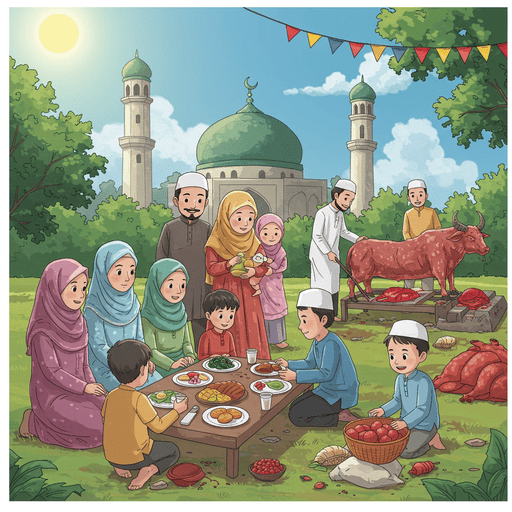
- Sharing Qurbani Meat: It is traditional to divide the meat in thirds; 1 third goes to the family, 1 third to friends and neighbours, and 1 third to the needy.
- Promoting Generosity: Eid al-Adha promotes giving, helping the poor, and being conscious of others needs.
- Building Unity: The celebration brings together Muslims from all backgrounds in joy and prayer, reinforcing the sense of belonging to a united global Muslim community (ummah).
Sacrifice during eid adha: conditions and proper etiquette
The tradition of sacrifice during Eid al-Adha is a cornerstone of Islamic practice, embodying the principles of faith, obedience, and generosity. However, Islam has established clear guidelines and appropriate behavior to guarantee that the sacrifice is performed ethically and holds profound spiritual significance.
Conditions for a Valid Sacrifice:
- Animal Type: The animal being sacrificed must be of livestock (camels, cows, sheep, or goats.)
- Age Requirement: The animal must be of the minimum age requirement of Islamic law.
- Free from Defects: The animal should be healthy and not have any visible defects such as blindness, serious lameness, or extreme thinness.
- Ownership: The animal must belong to the person offering the sacrifice or must be one they are authorized to sacrifice, either legally or by permission from the rightful owner.
- Free of Liens: The animal shouldn’t have any outstanding debts or claims from other people. Essentially, it needs to be fully owned by the person sacrificing it
- Correct Timing: The sacrifice must occur after the Eid prayer on the 10th of Dhu al-Hijjah and can be conducted over two or three subsequent days (until the 13th).
Proper Etiquette in Carrying Out the Sacrifice:
- Compassion and Privacy: Islam places great importance on being kind to animals. Because of this, it’s not allowed to sacrifice one animal in front of another, since seeing that would cause the watching animal a lot of unneeded worry. The whole process should be done in the gentlest and most respectful way possible.
- Sharp Tools: The knife used has to be really sharp, so that the process is quick and painless.
- Clean Environment: The sacrifice is to be made in a clean and respectful environment, preserving the dignity of the act.
- Distribution: The meat must be divided most equally, a portion for the family, a portion for any relatives or friends, and a portion for the poor and needy.
How do muslims celebrate Eid ul adha? Rituals & traditions
The festivities begin with a special communal prayer called Salat al-Eid, which takes place in open fields or mosques for the purpose of community. After the prayer, those who are able take part in the ritual sacrifice.
Other key practices include:
- Wearing new clothes:A Sunnah act that shows happiness and respect for the sacred occasion.
- Exchanging greetings and gifts: Greetings and gift-giving strengthen ties within the family and the community at large.
- Preparing traditional meals: Every culture has its special tastes that set the table for Eid.Generally, the meal is centered on the sacrificial meat.
- Sending and receiving gifts and greetings: This improves relationships both within the family and in the community.
Eid ul-Adha across different countries: cultural variations
- Eid in Middle East
Eid al-Adha is celebrated like no other part of the world in the Middle East. It feels even more special when you are in Saudi Arabia, especially Mecca during Hajj, it is truly the heart of the Muslim world. The sacrifice is extremely large, with Qurbani areas, and the meat is efficiently distributed to needy people worldwide through humanitarian organizations.
- Celebrations in South Asia
South Asia adds vibrant traditions to Eid. In Pakistan, “Bari Eid” (Big Eid) involves weeks of preparation, including lively mehndi nights where women apply henna and share stories. The food is a highlight, with dishes like fragrant beef biryani and sweet cardamom-flavored vermicelli (sewaiyan). In Bangladesh, a rich beef curry called korbani’r mangsho is popular. In addition to prayers and traditions, the playful exchange of Eidi among children makes the celebration extra special.
- Muslims and Eid in Western countries
Despite it not being recognized by the govebretas an official holiday. Many take personal days off, and mosques often rent large venues to host huge prayer gatherings. On Eid, they also celebrate with events similar to carnivals, where there might be food trucks or bazaars. Eid celebrations include sacrifices, which have to be done through halal farms or in conjunction with charitable organizations, due to local regulations, but families may still go to these halal farms to show their children what it means to sacrifice on Eid.
Each region celebrates Eid al-Adha with unique customs, making the festival a rich blend of faith and culture worldwide.
Learn more about Islam with E-hoopoe
At E-Hoopoe, we’re more than just an educational platform; we’re a growing community committed to reviving the values of unity, knowledge, and spirituality. We believe that learning about Islam should be a meaningful, accessible, and enriching experience for every Muslim regardless of their age, background, or level of knowledge. That’s why we’ve created a platform that goes beyond traditional classes.
Our uniquely developed online islamic course and online quran course are designed to guide you step by step, whether you’re just beginning your journey or seeking deeper understanding. With qualified teachers, captivating lessons, and study-at-your-own-pace opportunities, you can study at your own pace and truly connect with your faith.
Conclusion
For Muslims worldwide, Eid ul-Adha is a deeply meaningful holiday that represents unity, sacrifice, and devotion. Exploring how do Muslims celebrate Eid ul Adha emphasizes how this blessed festival brings together spiritual worship and wonderful cultural celebrations. From the sacred ritual of Qurbani to the comfort of family reunions and the spirit of universal giving, Eid ul-Adha remains a celebration that continues to evoke joy and strengthen bonds between the Muslim Ummah worldwide.
At E-hoopoe, we turn learning into spiritual growth. Through our thoughtfully designed Islamic classes, we guide you to deepen your understanding, reflect with purpose, and live your faith with confidence.
Explore our online Islamic classes today and book your free trial for any course of your choice.