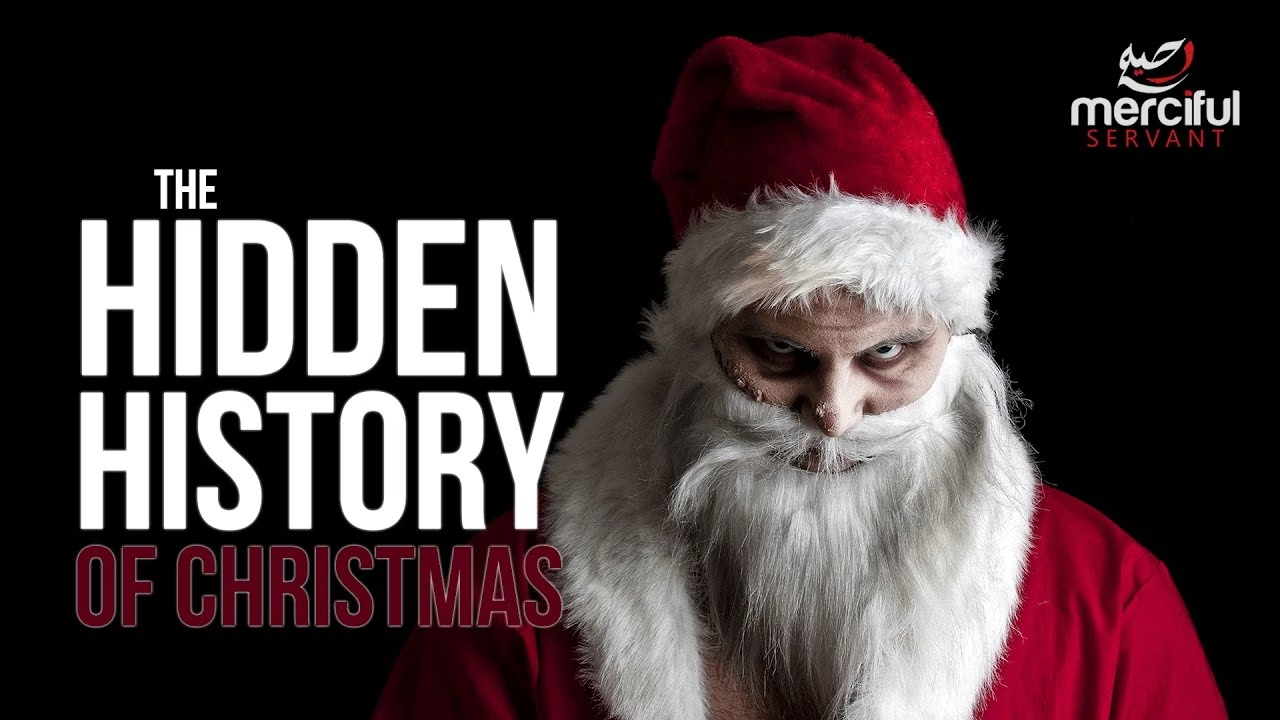
Discover the Muslim guide hidden pagan truth Christmas reveals about the widely celebrated holiday. Many assume Christmas is purely Christian, but its origins trace back to ancient pagan traditions. This guide uncovers the surprising historical facts every Muslim should know to understand the true nature of this festive celebration.
The Plain Truth About Christmas: What Every Muslim Should Know
Christmas, as widely celebrated in the West, is often misunderstood. Many assume it is a purely Christian tradition, yet historical evidence shows its roots lie in ancient pagan practices. This article draws on Islamic perspectives and research originally published in two Islamic magazines, highlighting the historical and religious realities behind Christmas celebrations.
Origins of Christmas
The first article, published in Al-I’tisam magazine in January 1980, is based on a booklet titled The Plain Truth About Christmas by the Christian researcher Herbert W. Armstrong. The booklet, published by the Worldwide Church of God in Pasadena, California, spans fifteen pages and argues, with historical evidence, that Christmas is a pagan festival with no original connection to Christianity or the true teachings of Jesus (peace be upon him).
Herbert Armstrong begins with a startling question:
“Where did Christmas come from – the Bible or paganism? Here are the shocking facts that may surprise you.”
Christmas and Historical Evidence
Armstrong cites multiple encyclopedias and historical references:
The term “Christmas” does not appear in the Bible and was never practiced by the apostles. It entered Christian tradition through pagan influence.
The Catholic Church introduced the celebration, transforming ancient Roman winter festivals—such as Saturnalia (17–24 December) and Brumalia (25 December)—into Christmas. These festivals celebrated the winter solstice and the rebirth of the sun.
Early Christians did not celebrate birthdays as joyous occasions; notable historical figures like Pharaoh and Herod were exceptions, not examples.
The British Encyclopaedia (1946 edition) also confirms that Christmas has no scriptural basis and was derived from pagan practices.
The Timing of Jesus’ Birth
Historical and biblical evidence indicates that Jesus (peace be upon him) was unlikely born in December. Shepherds were known to watch their flocks at night, which was uncommon in the cold winter of Palestine, suggesting a birth date before mid-October.
Pagan Influences on Christmas
Armstrong further explains that Constantine’s recognition of Christianity in the 4th century coincided with existing pagan customs. The 25th of December, originally celebrated as the birth of the Sun God, was repurposed as Jesus’ birthday to make Christianity more appealing to pagans in the Roman Empire. The festival retained its festive, vibrant nature, reflecting its pagan origins.
The Myth of the “Holy Child and Mother”
The celebration of Christmas also draws from ancient pagan worship of a mother-and-child deity, a practice widespread in Mesopotamia, Egypt, Rome, Greece, and Asia long before the birth of Jesus. Figures such as Nimrod and his mother Semiramis were central to these ancient myths. Over time, these pagan traditions were merged with Christian narratives under the guise of celebrating Jesus’ birth.
Modern Christmas Traditions
Today’s Christmas customs—decorating the holly, the figure of Santa Claus, and exchanging gifts—are all derived from these ancient pagan practices. They were never part of the life or teachings of Jesus (peace be upon him).
Conclusion
For Muslims, understanding the true origins of Christmas is crucial. It is not merely a holiday; it represents centuries of pagan influence masked under Christian symbolism, including elements of the Trinity that were introduced centuries after Jesus (peace be upon him) was raised to the heavens.
Learning Islam and adhering to its teachings protects believers from being misled by rituals and practices that contradict the faith.
The Ruling on Celebrating Christmas
What is the ruling on Muslims participating in Christmas celebrations?
Muslims are not permitted to participate with the People of the Book in celebrating Christmas (New Year’s Day), nor to congratulate them on this occasion. This is because Christmas is part of their religious practices, their own faith, or a symbol of their false beliefs. Islam forbids imitating them in their religious festivals. This ruling is supported by the Quran, Sunnah, scholarly consensus (Ijma), and reasoning.
1. Evidence from the Quran
Allah Almighty says:
وَالَّذِينَ لا يَشْهَدُونَ الزُّورَ وَإِذَا مَرُّوا بِاللَّغْوِ مَرُّوا كِرَاماً [الفرقان:72]
“And those who do not bear witness to falsehood, and when they pass by vain talk, they pass by with dignity.” (Al-Furqan: 72)
According to Mujahid in his tafsir, this verse refers to the festivals of the polytheists. Al-Rabi’ ibn Anas, Qadi Abu Ya’la, and Al-Dahhak expressed the same opinion. Ibn Sirin stated that “falsehood (الزور)” here refers to celebrations like Sha’aniyyin, a festival observed by Christians on the Sunday before Easter, commemorating Jesus’ entry into Jerusalem.
References: Iqtida’ al-Sirat al-Mustaqim 1/537, Al-Mujam al-Wasit 1/488
Explanation: If Allah praises avoiding merely witnessing their festivals (seeing or hearing), then participating in them actively, which is part of falsehood, is certainly prohibited.
2. Evidence from the Sunnah
Anas ibn Malik (RA) reported:
> “When the Messenger of Allah (ﷺ) arrived in Madinah, they had two days in which they used to play. He asked: ‘What are these two days?’ They replied: ‘We used to play on them during Jahiliyyah (pre-Islamic period).’ The Messenger of Allah (ﷺ) said: ‘Allah has replaced them for you with better days: the Day of Sacrifice (Eid al-Adha) and the Day of Breaking the Fast (Eid al-Fitr).’”
(Narrated by Abu Dawood, Ahmad, and An-Nasa’i, authenticated by Muslim’s standards)
Explanation: The Prophet (ﷺ) did not approve of the pre-Islamic celebrations nor allow Muslims to continue them. Instead, Allah replaced them with two sanctioned Islamic festivals, indicating that we should abandon pre-Islamic customs.
3. Evidence from Scholarly Consensus (Ijma)
Historical records show that Jews and Christians continued to celebrate their festivals in Muslim lands, yet no righteous Muslim ever joined them.
Umar ibn Al-Khattab (RA) stipulated in his agreements with the People of the Book that they could not publicly display their religious festivals in Muslim lands. This ruling was unanimously agreed upon by the companions and later jurists.
Umar (RA) said:
“Beware of the customs of foreigners, and do not enter the polytheists’ celebrations in their churches, for displeasure descends upon them.”
(Narrated by Abu Al-Sheikh Al-Asbahani and Al-Bayhaqi, with authentic chains)
Al-Bayhaqi also reports Umar (RA) saying:
“Avoid the enemies of Allah during their festivals.”
Book free trial to know a lot studies about this articles.