The Holy Quran is divided into 30 Juz, each containing a unique selection of Surahs. Among them, Juz Amma stands out as the final Juz, featuring 37 short yet incredibly powerful Surahs. These chapters, though brief in length, are filled with profound meanings and lessons that resonate deeply with every believer. Recited in daily prayers, this juz serves as a spiritual anchor, offering solace, guidance, and a closer connection to Allah.
In this blog, we will explore the meaning and themes of each Surah in Juz Amma, delving into the lessons they impart. We will also highlight the virtues of this final Juz and examine how every Surah in it carries important life lessons. By understanding the powerful themes within these short yet profound Surahs, we aim to deepen our connection with the Quran and reflect on how they guide us in our daily lives.
What is Juz Amma?
Juz 30 or amma is the final section of the Qur’an, comprising 37 short surahs. Most of these surahs were revealed in Mecca and played a significant role in inviting its people to embrace Islam. Due to its brevity and powerful themes, it is frequently recited in daily prayers
Juz Amma begins with Surah Al-Naba and includes other short surahs like Al-Ikhlas, which is considered one-third of the Qur’an in meaning. It also contains Surah Al-‘Alaq, marking the start of the Prophet Muhammad’s mission, and Surah An-Nasr, symbolizing the end of his prophetic journey.
The Juz’ overall serves as a reminder of Allah’s sovereignty, His control over the universe, and the certainty of the Hereafter. The surahs are concise but deliver profound reflections on faith and the ultimate fate of humanity.
Juz 30 Main Themes
- Oneness of Allah
- The Day of Judgment
- Consequences of actions
- Fate of the righteous vs. the wicked
- Importance of faith and righteousness
- Seeking refuge in Allah from evil
- The afterlife and resurrection
Number of Surahs in Juz Amma
This juz contains a total of 37 surahs. These surahs are generally shorter in length compared to those in other sections of the Qur’an.
|
Surah Name |
Number of Verses |
| Surah An-Naba | 40 |
| Surah An-Nazi’at | 46 |
| Surah Abasa | 42 |
| Surah At-Takwir | 29 |
| Surah Al-Infitar | 19 |
| Surah Al-Mutaffifin | 36 |
| Surah Al-Inshiqaq | 25 |
| Surah Al-Buruj | 22 |
| Surah At-Tariq | 17 |
| Surah Al-A’la | 19 |
| Surah Al-Ghashiyah | 26 |
| Surah Al-Fajr | 30 |
| Surah Al-Balad | 20 |
| Surah Ash-Shams | 15 |
| Surah Al-Layl | 21 |
| Surah Ad-Duha | 11 |
| Surah Ash-Sharh | 8 |
| Surah At-Tin | 8 |
| Surah Al-Alaq | 19 |
| Surah Al-Qadr | 5 |
| Surah Al-Bayyinah | 8 |
| Surah Az-Zalzalah | 8 |
| Surah Al-Adiyat | 11 |
| Surah Al-Qari’ah | 11 |
| Surah At-Takathur | 8 |
| Surah Al-Asr | 3 |
| Surah Al-Humazah | 9 |
| Surah Al-Fil | 5 |
| Surah Quraysh | 4 |
| Surah Al-Ma’un | 7 |
| Surah Al-Kawthar | 3 |
| Surah Al-Kafirun | 6 |
| Surah An-Nasr | 3 |
| Surah Al-Masad | 5 |
| Surah Al-Ikhlas | 4 |
| Surah Al-Falaq | 5 |
| Surah An-Nas |
6 |
Juz Amma Surahs
1- Surah An-Naba
A Meccan Surah discussing resurrection, revival, and recompense. It highlights Allah’s power in the universe, emphasizing His ability to resurrect humanity after death and contrasts the fate of the righteous and the disbelievers.
2- Surah An-Nazi’at
This Meccan Surah speaks about the Day of Judgment, the resurrection, and the upheavals that will occur. It also emphasizes the truth of revelation and the qualities of the messenger.
3- Surah ‘Abasa
Revealed in Mecca, this Surah highlights the inclusivity of the message of Islam, reminding the Prophet Muhammad of the importance of addressing everyone equally, regardless of their social status, and discusses the signs of Allah’s power and the consequences on the Day of Judgment.
4- Surah At-Takwir
A Meccan Surah that depicts the cataclysmic events of the Day of Judgment and the cosmic upheaval that will occur, as well as the nature of revelation and the messenger receiving it.
5- Surah Al-Infitar
Discusses the cosmic changes on the Day of Judgment, human denial of Allah’s blessings, and the deeds recorded by angels, which will be read on the Day of Reckoning.
6- Surah Al-Mutaffifin
This Surah condemns those who cheat others in transactions and assures them of punishment in the Hereafter. It contrasts the fate of the wicked with the bliss awaiting the righteous.
7- Surah Al-Inshiqaq
Talks about the sky splitting open on the Day of Judgment and the deeds of humans being presented. It emphasizes the reward for the good and the punishment for the wicked.
8- Surah Al-Buruj
A Meccan Surah recounting the story of the People of the Ditch and their sacrifice for their faith. It emphasizes the punishment for the wrongdoers and the significance of the Qur’an.
9- Surah At-Tariq
Discusses resurrection and emphasizes the power of Allah in creating humans and the universe, while also highlighting the truth of the Qur’an and the eventual punishment for the disbelievers.
10- Surah Al-A’la
A Meccan Surah that talks about the attributes of Allah, His power, the ease of preserving revelation for the Prophet, and the success of those who purify themselves and obey Allah.
11- Surah Al-Ghashiya
Speaks about the resurrection and the contrasting fates of the righteous and the disbelievers. It also points to the evidence of Allah’s existence through the signs in nature.
12- Surah Al-Fajr
Mentions the punishment of nations like ‘Ad, Thamud, and Pharaoh who denied their messengers. It also reflects on the test of wealth and poverty, highlighting the Day of Judgment’s division of people.
13- Surah Al-Balad
Talks about the hardships of human life and the struggle between righteousness and wretchedness. It emphasizes the rewards for the righteous and the consequences for the wicked.
14- Surah Ash-Shams
A Meccan Surah emphasizing the contrast between the soul’s purity and corruption, swearing by the sun, moon, day, night, sky, earth, and soul. It mentions the people of Thamud’s denial of Prophet Salih and their destruction, highlighting that success lies in purifying the soul, and failure in corrupting it.
15- Surah Al-Layl
A Meccan Surah emphasizing the diversity of human efforts. It contrasts the outcomes for those who give and fear Allah with those who withhold and deny the reward. The Surah concludes by reminding that wealth cannot save one from ruin.
16- Surah Ad-Duha
A Meccan Surah, comfort for the Prophet after a period of silence in revelation. Allah reassures him of His favor, reminding him to care for orphans and the needy. It emphasizes gratitude and worship in response to Allah’s blessings.
17- Surah Ash-Sharh
A Meccan Surah offering consolation to the Prophet, highlighting Allah’s blessings upon him, including expanding his chest and elevating his status. It reassures that ease follows hardship and urges devotion to worship.
18- Surah At-Tin
Surah At-Tin, a Meccan Surah, swears by three significant things: the fig, the olive, Mount Sinai, and the secure city of Mecca. These oaths highlight the purity and importance of these places; Mount Sinai where Allah spoke to Moses, and Mecca, the sacred city. The fig and olive represent the blessed land of Palestine. Allah emphasizes that just as He swore by these pure places, He created man in the best form. However, those who disobey Allah fall to the lowest state, while believers who do righteous deeds remain pure. The Surah concludes with a reminder of Allah’s justice in holding everyone accountable for their deeds.
19- Surah Al-‘Alaq
A Meccan Surah, the first revelation, calling mankind to read and seek knowledge in Allah’s name. It addresses man’s arrogance and rebellion against Allah, warning of punishment for those like Abu Jahl, and calls for prostration and worship.
20- Surah Al-Qadr
A Meccan Surah discussing the Night of Decree, where the Qur’an was revealed. It highlights the night’s significance, stating it is better than a thousand months and emphasizes the virtue of this blessed night.
21- Surah Al-Bayyina
A Medinan Surah addressing the People of the Book, declaring that the essence of worship is sincerity to Allah. It contrasts the eternal reward of the righteous with the punishment of disbelievers, urging worship and fear of Allah.
22- Surah Al-Zalzalah
A Medinan Surah describing the Day of Judgment, where the earth shakes and reveals its contents. Mankind is divided based on deeds, with the righteous rewarded and the wicked punished, even for the smallest actions.
23- Surah Al-Adiyat
A Meccan Surah swearing by the galloping horses, symbolizing the honor of warriors. It contrasts man’s ingratitude and love for wealth with the certainty that on Judgment Day, everyone will be judged for their deeds.
24- Surah Al-Qari’a
A Meccan Surah depicting the severity of the Day of Judgment, where people will be scattered like moths and mountains turned to wool. It differentiates between the righteous, rewarded with a pleasant life, and the wicked, destined for a blazing fire.
25- Surah At-Takathur
A Meccan Surah warning against the preoccupation with worldly gains, which distracts from worship. It cautions that the body perishes, and the soul ascends, urging balance between material and spiritual life.
26- Surah Al-Asr
A Meccan Surah emphasizes the value of time and work, highlighting that humanity is at a loss except for those who believe, do good deeds, and advise others to truth and patience. It teaches the essence of civilization and the importance of time.
27- Surah Al-Humazah
A Meccan Surah condemning backbiting, mocking others, and hoarding wealth. It warns of the punishment in Hell for those who do these acts, with imagery of the “Crusher” (Hellfire).
28- Surah Al-Fil
A Meccan Surah recounts the failed attempt of Abraha to destroy the Kaaba, illustrating how arrogant oppressors face downfall, with Allah sending birds to defeat them.
29- Surah Quraysh
A Meccan Surah reminds the Quraysh of Allah’s blessings, like security and trade, and urges them to worship and thank Him for these gifts.
30- Surah Al-Ma’un
A Meccan Surah addresses two types of people: those who deny God’s blessings and those who show off in their worship while neglecting the poor and needy.
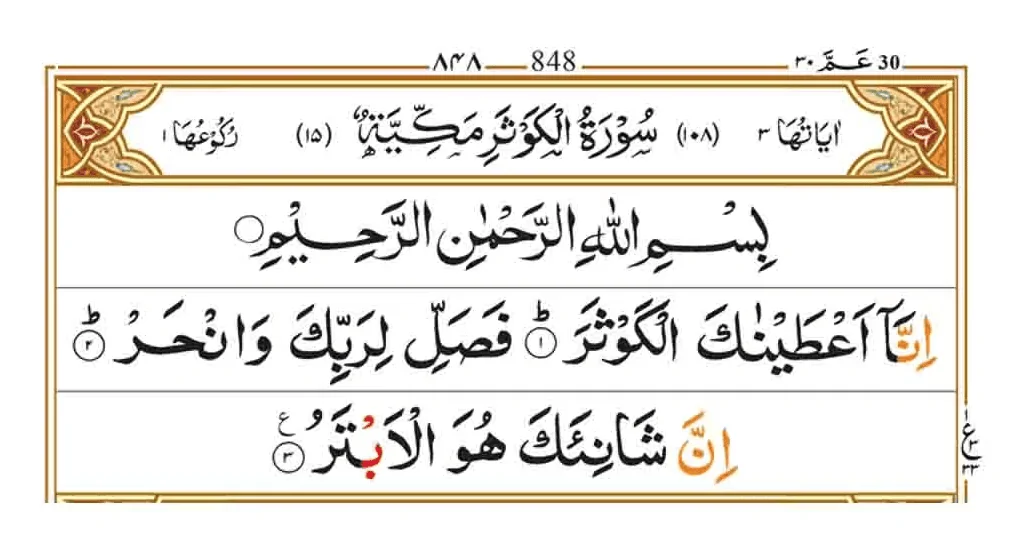
31- Surah Al-Kawthar
A Meccan Surah celebrating the abundant blessings of Allah upon the Prophet Muhammad, urging gratitude through prayer and sacrifice.
32- Surah Al-Kafirun
A Meccan Surah rejects compromise with polytheism, emphasizing that Islam is the true religion and there is no room for worship of other gods.
33- Surah Al-Nasr
A Medinan Surah announces the conquest of Mecca, urging Muslims to seek forgiveness to protect against arrogance after great victories.
34- Surah Al-Masad
A Meccan Surah condemned Abu Lahab and his wife for opposing the Prophet, with a dire warning of punishment in Hell for their actions.
35- Surah Al-Ikhlas
A Meccan Surah defines the oneness and purity of Allah, refuting the concepts of Trinity and polytheism, and emphasizing that Allah is unique and without equals.
36- Surah Al-Falaq
A Meccan Surah where believers seek refuge in Allah from the evils of creation, including darkness, envy, and witchcraft.
37- Surah An-Nas
A Meccan Surah where believers seek protection from the evil whispers of Satan, seeking refuge with the Lord, King, and God of mankind. It concludes the Quran by emphasizing reliance on Allah.
Virtues of Juz Amma
- Frequent Recitation in Prayers: Surahs from this juz are often recited in daily prayers (Salah), especially in the first two Rak’ahs, helping to strengthen the connection with Allah.
- Easy to Memorize: This Juz is short, making it easy to memorize. It is usually the first Juz taught to children and new learners of the Quran.
- Great Rewards: Reciting Juz 30 brings immense rewards. The Prophet (PBUH) said that each letter recited from the Quran brings ten rewards.
- Guidance and Protection: Surahs like Al-Falaq and An-Nas offer protection from evil and harm. Regular recitation shields the believer from negativity.
- Essence of Tawheed: It emphasizes the Oneness of Allah, especially through Surah Al-Ikhlas, which encapsulates the core of monotheism.
- Intercession on the Day of Judgment: Surah Al-Mulk and Surah Al-Ikhlas will intercede for those who recite them regularly, providing protection and blessings on the Day of Judgment.
- Strengthening Faith: Reciting it helps to reinforce faith, trust in Allah, and reliance on His guidance in life’s challenges.
- Encourages Patience: Many Surahs in Juz Amma teach patience and trusting Allah during times of difficulty.
Easy Ways to Memorize Juz Amma for Beginners
- Set a Clear Timeline: Determine your desired timeline for memorizing it based on your personal schedule and learning pace.
- Divide Into Manageable Sections: Break the juz into smaller parts. You can divide it by surahs, groups of surahs, or into four equal sections; whatever feels more manageable for you.
- Create a Daily Routine: Set aside specific time each day for memorization and practice consistency.
- Regular Revision: To retain what you memorize, make time for daily revisions. This helps strengthen your memory and prevents forgetting.
- Understand the Meaning: Take the time to truly understand the meaning and context of each Surah. By joining the E-hoopoe online Quran memorization course, you’ll enhance your memorization skills and deepen your connection to the Quran.
- Seek Guidance: If possible, get a mentor or teacher to help correct your recitation and provide tips for more effective memorization.
- Celebrate Milestones: Celebrate small victories, such as memorizing a surah or completing a section. This helps you stay motivated while learning.
- Be Patient and Consistent: Memorizing the Quran takes time, patience, and perseverance. Trust yourself and stay consistent with your efforts.
Learn Quran Online with E-hoopoe
E-hoopoe delivers a personalized and flexible online Quran learning experience, making it simple to engage with the sacred text. With expert teachers who cater lessons to your specific goals, the platform adapts to your pace. Lessons are scheduled at your convenience, easily fitting into your daily routine. Through interactive sessions and immediate feedback, E-hoopoe creates an environment where learning is both enriching and effective, empowering students to deepen their connection to the Quran no matter where they are.
Conclusion
Frequently Asked Questions
- When were the surahs of Juz Amma revealed to the Prophet?
The juz surahs were revealed at different times throughout the Prophet Muhammad’s life, primarily during his time in Makkah, when the Muslim community was small and facing persecution. Some surahs were revealed in Madinah, but most of them were revealed in Makkah.
- What is the total number of ayat in Juz Amma?
Juz Amma contains 37 surahs and a total of 564 verses (ayat).