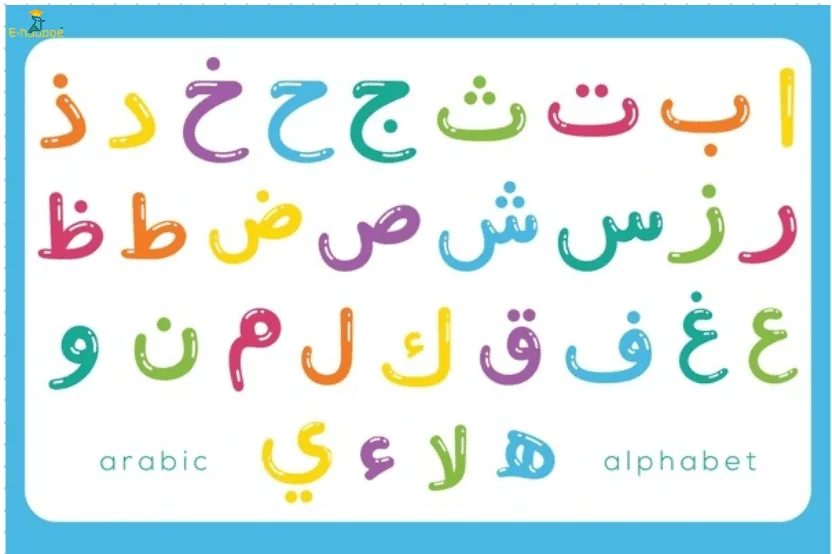
Learning to write Arabic letters can be simple and enjoyable. For non-Arabic speaking Muslims in the UK, US, and Canada, starting with the basic letter shapes and pronunciation builds strong reading and writing skills. With guided lessons from E-Hoopoe, you can master each letter’s form, sound, and flow — connecting beautifully with the Qur’an and the Arabic language.
Learning how to write Arabic letters for beginners can seem overwhelming at first — especially for those used to the English alphabet. The script flows from right to left, the letters connect in a cursive style, and many shapes are completely new. But let’s agree that with the right approach, writing Arabic becomes a smooth and rewarding journey.
This guide is designed to simplify the process, break down the basics, and help you build confidence from your very first letter, allowing you to take the first step toward unlocking the richness of the Arabic language.
How many letters are in the Arabic alphabet?
There are 28 letters in the Arabic alphabet. Each of these letters represents a consonant, unlike in English where vowels have their own letters. Moreover, Arabic is read and written from right to left, which is one of the most important distinctions for new learners to be aware of.
Features of the Arabic alphabet
The Arabic alphabet has a unique structure and style that makes it stand out among world languages. Here are the key features every beginner should know:
- Right-to-left script: Arabic is written and read from right to left, which may feel unfamiliar to learners used to Latin-based languages like English.
- Cursive writing: Unlike English, where printed letters are separate, Arabic letters are usually connected in a cursive form. This flowing script creates a smooth rhythm in writing.
- Letters change shape: Most Arabic letters change shape based on where they occur in a word. The same letter will look different at the beginning, middle, end, and when written alone.
- Consonant-based alphabet: Arabic mainly uses letters for consonants. Long vowels appear as specific letters (ا، و، ي), while short vowels are shown with small marks, not full letters.
- Vowel markings (Diacritics): Short vowel sounds are represented by diacritical marks (small symbols written above or below the letters). These are often used in books for learners or in religious texts like the Qur’an
Comparing between the Arabic and English alphabets
- There are 28 letters in Arabic, only two more than the 26 letters in English
- English uses both uppercase and lowercase letters, but Arabic does not have capital or small letters.
- Some Arabic letters represent sounds that don’t exist in English, such as ع (Ayn), ح (Ḥaa’), and ض (Dhad), which can be challenging for English speakers to pronounce.
- English represents vowel sounds using full letters (a, e, i, o, u), while Arabic uses diacritical marks for short vowels and specific letters (ا، و، ي) for long vowels.
| Feature | Arabic Alphabet | English Alphabet |
| Number of Letters | 28 letters | 26 letters |
| Type of Letters | Mostly consonants; long vowels (ا، و، ي) | Consonants and vowels (a, e, i, o, u) |
| Short Vowels | Shown with diacritical marks ( َ ِ ُ ) | Represented by full letters |
| Writing Direction | Right to left | Left to right |
| Letter Connection | Letters are usually connected (cursive) | Letters are mostly written separately |
| Capitalization | No uppercase or lowercase | Has both uppercase and lowercase letters |
| Letter Shapes | Letters change shape based on word position | Letters stay the same shape |
Arabic letters and their English sounds
| Arabic Letter | Name (Transliteration) | Closest English Sound |
| أ | Alif | A (as in “apple”) |
| ب | Baa | B (as in “bat”) |
| ت | Taa | T (as in “top”) |
| ث | Thaa | Th (as in “think”) |
| ج | Jeem | J (as in “jam”) |
| ح | Haa | H (strong breathy H) |
| خ | Khaa | Kh (like “loch”) |
| د | Daal | D (as in “dog”) |
| ذ | Dhaal | Th (as in “that”) |
| ر | Raa | Rolled R (like in Spanish) |
| ز | Zay | Z (as in “zoo”) |
| س | Seen | S (as in “sun”) |
| ش | Sheen | Sh (as in “shoe”) |
| ص | Saad | S (emphatic) |
| ض | Daad | D (emphatic, unique to Arabic) |
| ط | Taa | T (emphatic) |
| ظ | Zhaa | Z (emphatic) |
| ع | Ayn | Deep throat A |
| غ | Ghayn | Gh (like French “r”) |
| ف | Faa | F (as in “fun”) |
| ق | Qaaf | Q (deep K) |
| ك | Kaaf | K (as in “kite”) |
| ل | Laam | L (as in “love”) |
| م | Meem | M (as in “man”) |
| ن | Noon | N (as in “no”) |
| هـ | Haa | H (as in “hat”) |
| و | Waaw | W (as in “water”) / oo |
| ي | Yaa | Y (as in “yes”) / ee |
How to write arabic letters for beginners: 4 simple tips
- Practice Reading Aloud: Get used to the sounds and shapes of Arabic letters by reading them out loud regularly. This reinforces the link between what you see and hear.
- Learn the Names of the Letters: Knowing the Arabic names of the letters helps with memorization and builds a foundation for spelling and pronunciation.
- Grouping Similar (in shape)Letters: Some letters are similar to one another, but are distinguished by dots (e.g. ب، ت، ث). Studying them in groups makes them easier to remember and reduces mix-ups.
- Write Step by Step: Practice each letter alone first. Try combining letters to create simple words once you feel at ease. Observe how the shapes of letters vary according to where they are in a word.
Learn the Arabic Alphabet with E-hoopoe
At E-hoopoe, our online arabic course are designed to grow with students step by step, starting from learning how to write Arabic letters for beginners and progressing toward more advanced levels. We combine visual tools, writing practice, and interactive materials to make the learning experience clear, engaging, and accessible.
Through step-by-step guidance, learners build confidence as they move from recognizing letters to writing them with ease. With E-hoopoe, learning Arabic becomes approachable, effective, and enjoyable for new learners.
Join E-hoopoe and explore our full range of Arabic courses designed to take you from beginner to advanced levels