If you’ve ever wondered Arabic vs Urdu — what’s actually different, what’s surprisingly similar, and which one is easier to learn — you’re not alone. Thousands of Muslim families in the UK, USA, Canada, Australia, Norway, and the UAE ask the same question every year, especially when the goal is clear: understand the Qur’an, improve Islamic knowledge, and help kids build a strong Muslim identity.
In this guide, we’ll break down the key differences between Arabic and Urdu (alphabet, pronunciation, grammar, vocabulary, and writing), reveal the real similarities that confuse learners, and give you proven learning tips that work for adults and children. And if you want the fastest shortcut, you can join E-Hoopoe’s Arabic & Quran courses and start learning step-by-step with structured lessons — so you stop guessing, stop wasting time, and finally make real progress.
Arabic stands among the most widely spoken and culturally influential languages in the world. Its reach extends far beyond the Arab world, leaving its mark on languages like Persian, Turkish, and notably, Urdu. Though Urdu and Arabic may look similar at first glance, the difference between Arabic and Urdu language is significant
In this blog, we’ll take a closer look at how these two beautiful languages connect, where they differ, and why understanding their relationship is both fascinating and valuable, especially for Urdu speakers interested in learning Arabic.
Introducing the Urdu language
Urdu is a beautiful, expressive language that is spoken by millions of people across South Asia.. It is the national language of Pakistan and one of the official languages of six Indian states, thereby playing a significant role in the linguistic and cultural fabric of the region.
Although Urdu is classified under the Indo-European language family, it extensively incorporates elements from Arabic, Persian, and Sanskrit in its vocabulary and structure.
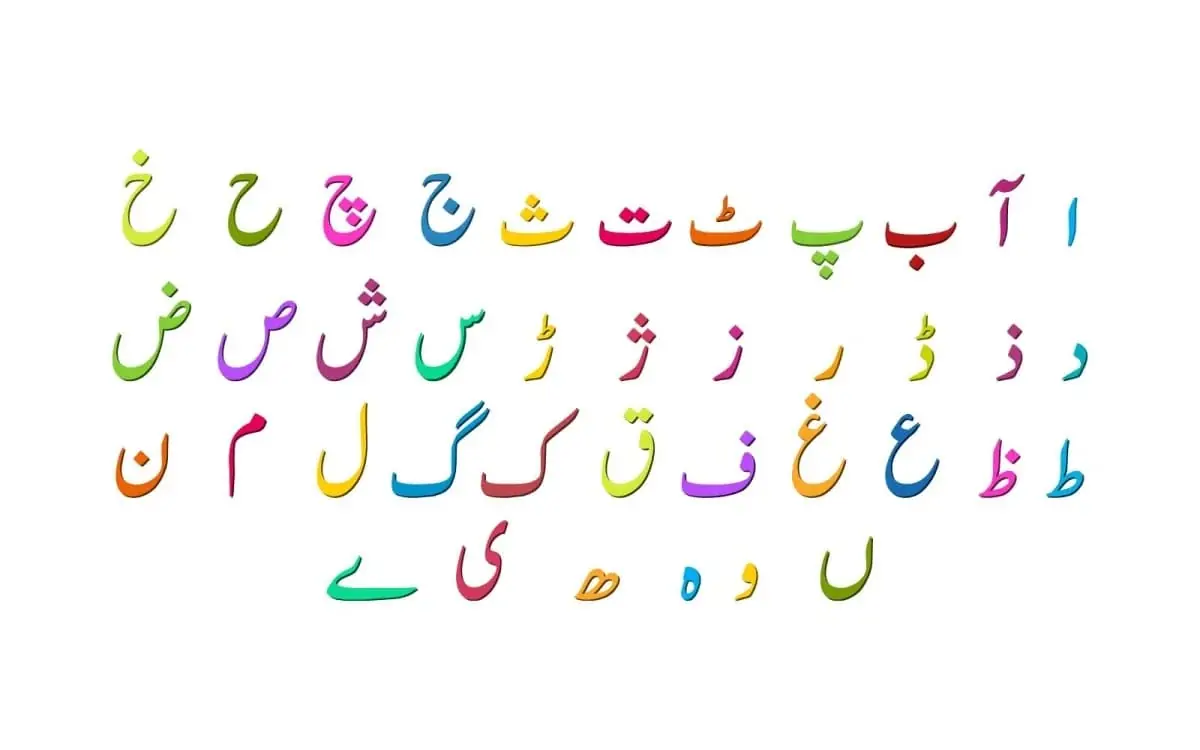
The script employed for writing Urdu is known as Nastaʿlīq, a calligraphic style derived from the Perso-Arabic script, renowned for its elegant, flowing lines.
Urdu uses 39 to 40 letters, mostly adapted from the Persian alphabet, which in turn is based on Arabic. Moreover, many commonly used Urdu words have Arabic origins.Urdu is a beautiful and expressive language spoken by millions across South Asia.
It is the national language of Pakistan and one of the official languages in several Indian states, making it an important part of the region’s cultural and linguistic identity.
Although Urdu belongs to the Indo-European language family, it is heavily influenced by Arabic, Persian, and Sanskrit. This rich blend gives Urdu its unique vocabulary and structure.
Urdu is written in the elegant Nastaʿlīq script, a calligraphic style derived from the Perso-Arabic script, known for its flowing and artistic appearance.
The language uses around 39 to 40 letters, mostly adapted from the Persian alphabet, which itself is based on Arabic.
Many commonly used Urdu words also have Arabic origins, which explains why Urdu speakers often find some familiarity when encountering Arabic terms—especially in Islamic contexts.
How similar is Urdu to Arabic?
At first glance, Urdu and Arabic may appear closely related especially to new learners, but the reality is a bit complex. Despite their visual and cultural connections, the two languages actually belong to entirely different language families; Urdu is Indo-European, while Arabic is Semitic.
Similarities:
- Writing System: Urdu uses the Nastaʿlīq script, which is a stylized form of the Perso-Arabic script derived from Arabic. This means many letters are visually similar.
- Vocabulary: Urdu contains a large number of Arabic-derived words, particularly in religious, academic, and literary contexts.
- Writing Direction: Both languages are written from right to left, making Arabic feel naturally aligned with how Urdu speakers already read and write.
So, while Urdu and Arabic share elements in script, vocabulary, and writing direction, they remain distinct languages. These shared features, however, offer a helpful foundation for Urdu speakers beginning to learn Arabic.
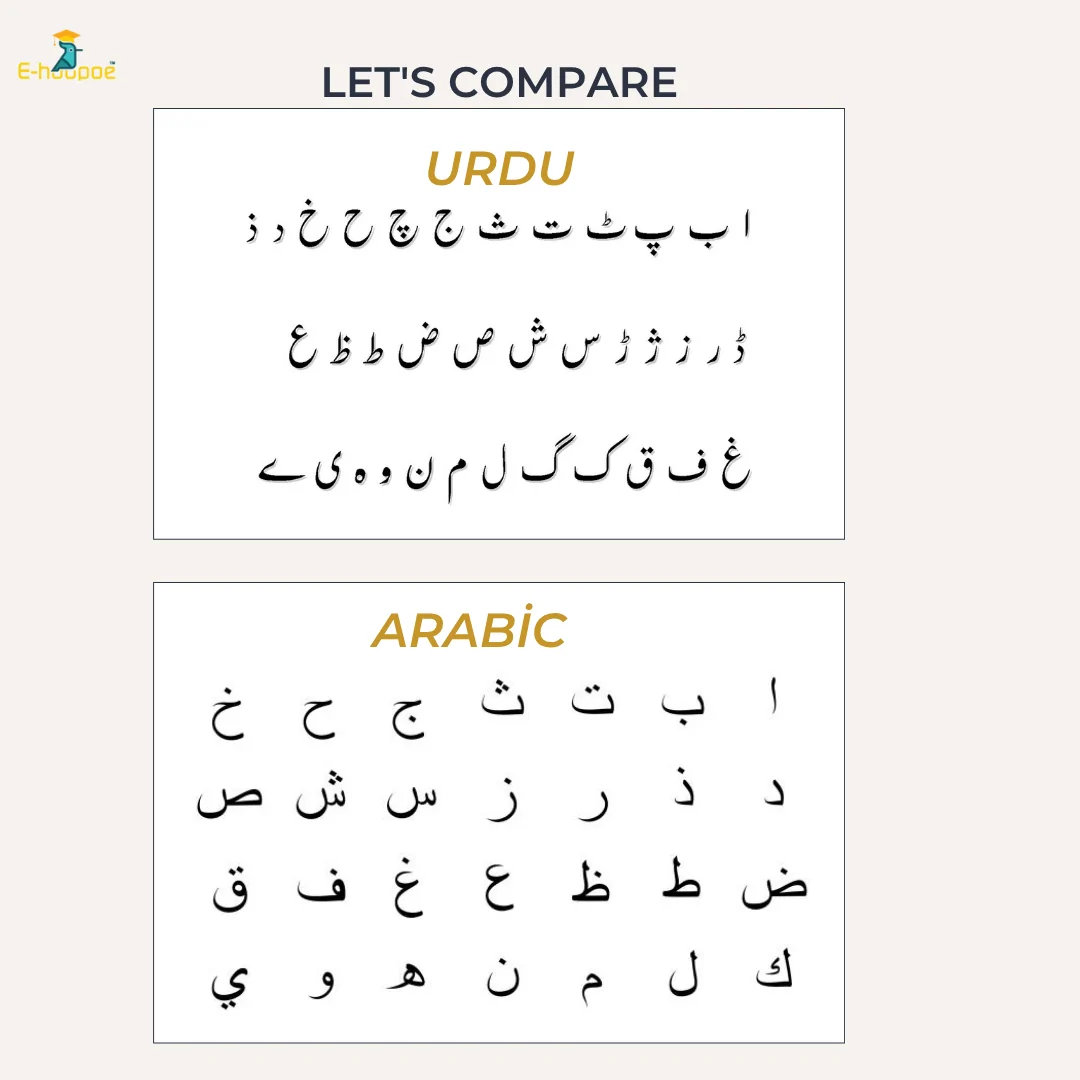
Key difference between Arabic vs Urdu language
The main difference between Arabic and Urdu language lies in their language families and grammatical roots. Arabic is a Semitic language that belongs to the Afro-Asiatic family, while Urdu is an Indo-Aryan language, part of the Indo-European family. This core distinction shapes everything from their grammar to sentence structure.
There are several other key differences between the two languages including:
- Script Style: Both employ an Arabic script, but Arabic is usually written in the Naskh script, whereas Urdu is written in a flowing, calligraphic style known as Nastaʿlīq.
- Alphabet: Urdu has 39 or 40 letters, including additional ones to represent sounds not found in Arabic. In contrast, there are only 28 fundamental letters in Arabic.
- Pronunciation: Despite shared vocabulary, many words are pronounced differently. Urdu leans more toward Persian-style pronunciation, while Arabic maintains its own distinct phonetics.
- Word Origins: Urdu borrows from Persian, Arabic, and Sanskrit, while Arabic is influenced by Hebrew, Aramaic, and Ethiopic languages.
Is it easy for Urdu speakers to understand Arabic?
No, it’s not easy. Although both languages share a similar script and some Arabic loanwords, the overall comprehension gap remains large. An Urdu speaker with no prior exposure to Arabic may be able to recognize letters and read aloud basic words, thanks to the shared script (Nastaʿlīq in Urdu, derived from Arabic’s Naskh). However, understanding the meaning of what they read is far more difficult.
This is due to some barriers:
- Grammar and sentence structure: Arabic grammar is very different from Urdu and follows unique root-based patterns.
- Vocabulary usage: Even shared words often have different meanings or contexts.
- Pronunciation: The way words are spoken differs significantly, which affects listening comprehension.
Examples of Arabic words in everyday Urdu
Arabic has strongly influenced Urdu, especially in formal, poetic, and religious terms. Today, a lot of Arabic words are used in everyday Urdu speech.
Common examples:
- Aakhir (آخِر): meaning last or final.
- Awwal (أول): meaning first or foremost.
- Aadaab (أدب): meaning manners or etiquette.
- Baab (باب): meaning door or chapter.
- Hayaat (حَياة): meaning life or existence, often found in both poetry and daily speech.
- Insaan (إنسان): meaning human being, widely used in general conversation, and media.
- Bait (بَيت): meaning house, but also used in poetry to refer to a verse or line of poetry.
If you’ve ever wondered whether Arabic vs Urdu are truly similar — or completely different — this guide, Arabic vs Urdu: Discover the Surprising Differences Every Muslim Should Know, breaks it down clearly. While both languages are deeply connected to Islamic culture, Arabic is the language of the Qur’an and primary Islamic sources, whereas Urdu developed later in South Asia, influenced by Persian and regional languages. Understanding the difference isn’t just linguistic — it shapes how you access authentic knowledge, interpret texts, and connect with the original sources of Islam.
For deeper learning and structured classes, you can explore trusted Islamic centers offering Arabic programs and Islamic studies. In the UK:
• Islamic Centre of England – London
• Islamic Dawah Centre (IDC)
In the United States:
• Islamic Center of America – Dearborn, Michigan
• Islamic Center of Southern California – Los Angeles
• Islamic Cultural Center of New York
These centers provide access to qualified teachers and structured programs that help Muslims move beyond translations and truly understand the language of revelation
Learn to speak Arabic fluently with E-hoopoe
Arabic can connect you with over 20 countries, diverse traditions, and centuries of history. And at E-hoopoe, we’re here to guide you every step of the way. Our uniquely designed Arabic Grammar Course and other Arabic classes are more than just language lessons; they’re a gateway to meaningful communication and cultural connection. With a tailored approach that adapts to your pace, background, and personal goals, you’ll start speaking Arabic with confidence and clarity.
Get started with E-hoopoe’s Arabic classes and start speaking with confidence.
For readers who want to dive deeper, there are several excellent external resources to explore the history and structure of Arabic and Urdu languages, as well as Islamic studies. Trusted references include Wikipedia – Arabic Language, Wikipedia – Urdu Language, British Council Arabic Learning, Islamic Society of North America, and Quranic Arabic Corpus. These sources provide detailed insights into pronunciation, grammar, script, and practical learning strategies for both adults and children.